
core-jmp

core-jmp

death of core jump

  • Home
  • windows
  • Reverse Engineering
  • exploitation
  • shellcode
  • About
  • Privacy Policy

HomeMalware

Posts in category: Malware

Inside the Trojanized CPU-Z Campaign: DLL Sideloading, Zig Malware, and Multi-Layer Persistence

Inside the Trojanized CPU-Z Campaign: DLL Sideloading, Zig Malware, and Multi-Layer Persistence

April 13, 2026
by oxfemale DLL SideloadingMalwarepowershellReverse Engineering

A trojanized CPU-Z package installs malware through CRYPTBASE.dll sideloading. The Zig-compiled DLL decodes an embedded payload, loads a reflective backdoor, connects to C2, and establishes persistence using PowerShell, COM hijacking, and scheduled tasks.

Read More
Tutorial: Adaptix C2 with ShellcodePack and MacroPack

Tutorial: Adaptix C2 with ShellcodePack and MacroPack

April 9, 2026
by oxfemale EDRMalwareshellcode

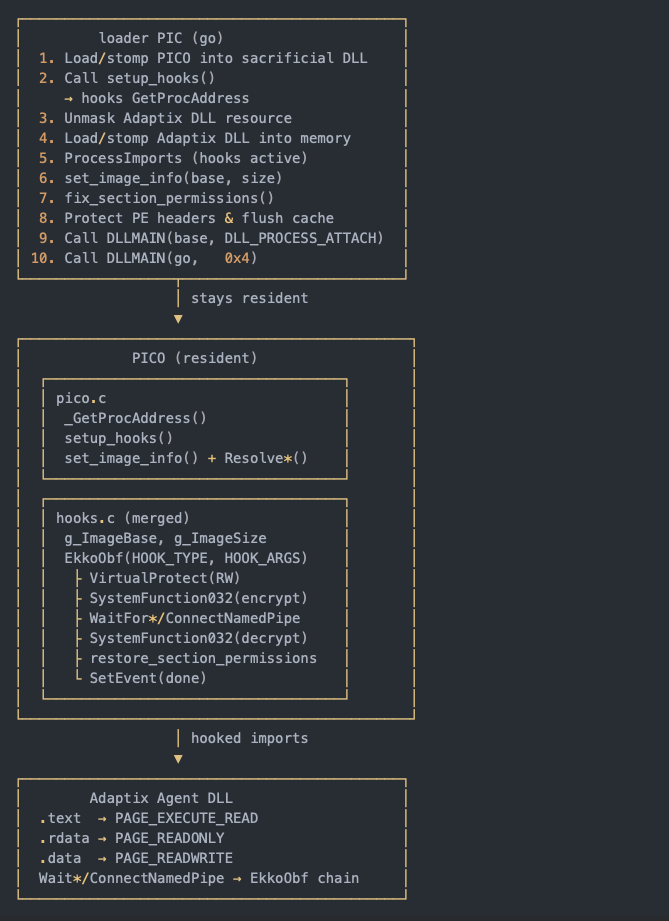
This tutorial shows how to weaponize Adaptix C2 agents using ShellcodePack and MacroPack, converting payloads into shellcode and packaging them in evasive loaders to improve stealth and bypass EDR during red-team operations.

Read More
COMouflage: Stealthy DLL Surrogate Injection for Process Tree Evasion

COMouflage: Stealthy DLL Surrogate Injection for Process Tree Evasion

April 7, 2026
by oxfemale BypassingCOMcppEDRInjectionMalwarePoCRedTeamwinapiwinapiwindows

COMouflage is a stealthy Windows injection technique that abuses COM DLL Surrogates to execute malicious DLLs inside dllhost.exe, making svchost.exe appear as the parent process and hiding the attacker’s process from detection.

Read More
Blinding the Defenders: Inside Qilin’s EDR-Killer Malware

Blinding the Defenders: Inside Qilin’s EDR-Killer Malware

April 3, 2026
by oxfemale CiscoEDRMalwareReverse Engineering

Cisco Talos analyzes a Qilin ransomware EDR-killer that disables over 300 security drivers. The multi-stage malware uses obfuscation and kernel-level techniques to bypass endpoint defenses and hide attacker activity.

Read More
Inside the Payload: Manual Shellcode Analysis with Ghidra

Inside the Payload: Manual Shellcode Analysis with Ghidra

March 31, 2026
by oxfemale DebugGhidraMalwareReverse Engineeringshellcodewinapiwinapiwindows

The article demonstrates how to analyze Windows shellcode in Ghidra by identifying API-hashing routines, resolving hidden Windows API calls, and extracting C2 infrastructure without relying on automated emulation tools.

Read More
Can it Resolve DOOM? Game Engine in 2,000 DNS Records

Can it Resolve DOOM? Game Engine in 2,000 DNS Records

March 22, 2026
by oxfemale .NETDNSMalwarePoCpowershellRedTeam

The article shows a proof-of-concept where DOOM is stored across ~2,000 DNS TXT records and executed directly from memory. A PowerShell loader reconstructs the binary via DNS queries, illustrating how DNS can act as a covert payload delivery system.

Read More
Invisible Execution: Hiding Malware with Unwind Metadata Manipulation

Invisible Execution: Hiding Malware with Unwind Metadata Manipulation

March 20, 2026
by oxfemale BYOUDEDRMalwarewindows

The article introduces BYOUD, a Windows evasion technique that manipulates unwind metadata to spoof call stacks without altering return addresses, allowing malware to bypass EDR stack inspection and appear as legitimate execution.

Read More
Reverse engineering undocumented Windows Kernel features to work with the EDR

Reverse engineering undocumented Windows Kernel features to work with the EDR

March 14, 2026
by oxfemale AntivirusBypassingDefenderEDREventlogkernelMalwareProtectionReverse EngineeringSecuritywinapiwinapiWinDBGwindows

This article demonstrates how to reverse engineer the Windows 11 kernel to understand undocumented internals behind memory operations and ETW Threat Intelligence events, helping security engineers improve EDR telemetry and detect remote process memory writes.

Read More
Malware and cryptography 44 - encrypt/decrypt payload via Discrete Fourier Transform. Simple C example.

Malware and cryptography 44 – encrypt/decrypt payload via Discrete Fourier Transform. Simple C example.

March 10, 2026
by oxfemale cppCryptographyEncryptionMalwarepowershellpowershellshellcodewindows

Demonstration how malware can encrypt and decrypt payloads using the Discrete Fourier Transform (DFT). It provides a simple C example showing how mathematical transforms can hide shellcode and help evade static signature-based detection.

Read More

Recent Posts

  • 89 vulnerabilities in XAPI / Citrix XenServer
  • Patchless AMSI Bypass via Page Guard Exceptions
  • A Step-by-Step Guide to Uncovering Vulnerabilities in a Mobile App
  • How Kernel Anti-Cheats Work: A Deep Dive into Modern Game Protection
  • A Shortcut to Coercion: Incomplete Patch of APT28’s Zero-Day Leads to CVE-2026-32202

Archives

  • April 2026
  • March 2026
  • February 2026
  • January 2026
  • November 2025
  • September 2025

Active Directory Active Directory Security Application Security byovd bypass cpp EDR EDR Bypass EDR Evasion EDREvasion Embedded Security Endpoint Security Exploit Development Firmware Reverse Engineering Hardware Hacking Hardware Security injection IoT Security Kernel Debugging Kernel Exploitation macOS Security Malware Analysis Malware Development Memory Corruption Offensive Security Post-Exploitation PPL Privilege Escalation Process Injection red team RedTeam Red Teaming Red Team Techniques remote code execution Reverse Engineering Security Research shellcode Vulnerability Research WinDBG windows Windows 11 Windows Internals Windows Kernel Windows security WindowsSecurity

Categories

  • .NET
  • access
  • ACE
  • ACL
  • Active Directory
  • Active Directory
  • AD CS
  • Administrator
  • AI Agents
  • AI Security Research
  • alloc
  • ALPC
  • AMSI
  • Android
  • Antivirus
  • Apache Tomcat
  • APC
  • Apple Silicon
  • ASM
  • ASR
  • attaks
  • Audio
  • AV
  • BIOS
  • BitLocker
  • Blue team
  • Bluetooth
  • Boot ROM
  • Broadcom
  • BSoD
  • buffer overflow
  • BYOUD
  • BYOVD
  • Bypassing
  • Cache
  • Callbacks
  • Camera
  • CI/CD
  • CIMOM
  • Cisco
  • Citrix
  • Claude AI
  • CLFS
  • cmd
  • COM
  • Command Injection
  • Containers
  • Copilot
  • Cortex XDR
  • CPL
  • cpp
  • CPU
  • Credential Attacks
  • Crypt
  • Cryptography
  • CryptoPro
  • CSRF
  • DCOM
  • Debug
  • Defender
  • DEP
  • Deserialization
  • DFIR
  • DLL Sideloading
  • DMA
  • DNS
  • Driver
  • dump
  • EDR
  • Embedded
  • Encryption
  • Escalation
  • ESP32
  • ESXi
  • Evasion
  • Eventlog
  • Exploit Development
  • exploitation
  • filesystem
  • firmware
  • Flash
  • FreeBSD
  • Gadgets
  • GATT
  • Ghidra
  • Hardware
  • Hooking
  • Hyper-V
  • Hypervisor
  • Impacket
  • impact
  • Injection
  • IOCTL
  • IoT
  • IPC
  • IRP
  • Java
  • JIT
  • JWT Security
  • Kerberos
  • kernel
  • kernel-mode
  • LDAP Relay
  • Library
  • Linux
  • LLM
  • LLM Exploit Development
  • LNK
  • Loader
  • LOLExfil
  • LSA
  • LSASS
  • Machine Learning
  • MacOS
  • Malware
  • MCP
  • MS-DOS
  • MS-EVEN
  • MS-LSAD
  • MS-SAMR
  • Network
  • NTLM Relay
  • NVMe
  • ODR
  • Palo Alto
  • PBA
  • PCI
  • PEB
  • Penetration Testing
  • PHP
  • pipe
  • Plugins
  • PoC
  • powershell
  • powershell
  • PPL
  • Privilege
  • Privilege Escalation
  • Protection
  • PXE
  • Python
  • QEMU
  • Race Condition
  • radare2
  • RCE
  • Recall
  • Recovery mode
  • RedTeam
  • Registry
  • Reverse Engineering
  • root
  • ROP
  • RPC
  • RTTI
  • Rust
  • SAM
  • Secure Boot
  • Security
  • Security
  • shellcode
  • Shortcut
  • SPI Flash
  • Stack Overflow
  • STM32H5
  • TCP/IP
  • TEB
  • Telegram
  • Telnetd
  • TPM
  • UAC
  • UART
  • UEFI
  • Uncategorized
  • USB
  • Use-After-Free
  • user-mode
  • Virtualization
  • VMProtect
  • VMware
  • Warbird
  • WASM
  • WEB
  • winapi
  • winapi
  • WinDBG
  • windows
  • Windows Admin Center
  • Winsock
  • WMI
  • WML
  • Wordpress
  • WSL
  • XenServer
  • Xiaomi
  • XML
  • XNU Kernel
  • XSS
  • XXE
Log in
    © 2026 core-jmp. All rights reserved.
    Shopping Basket