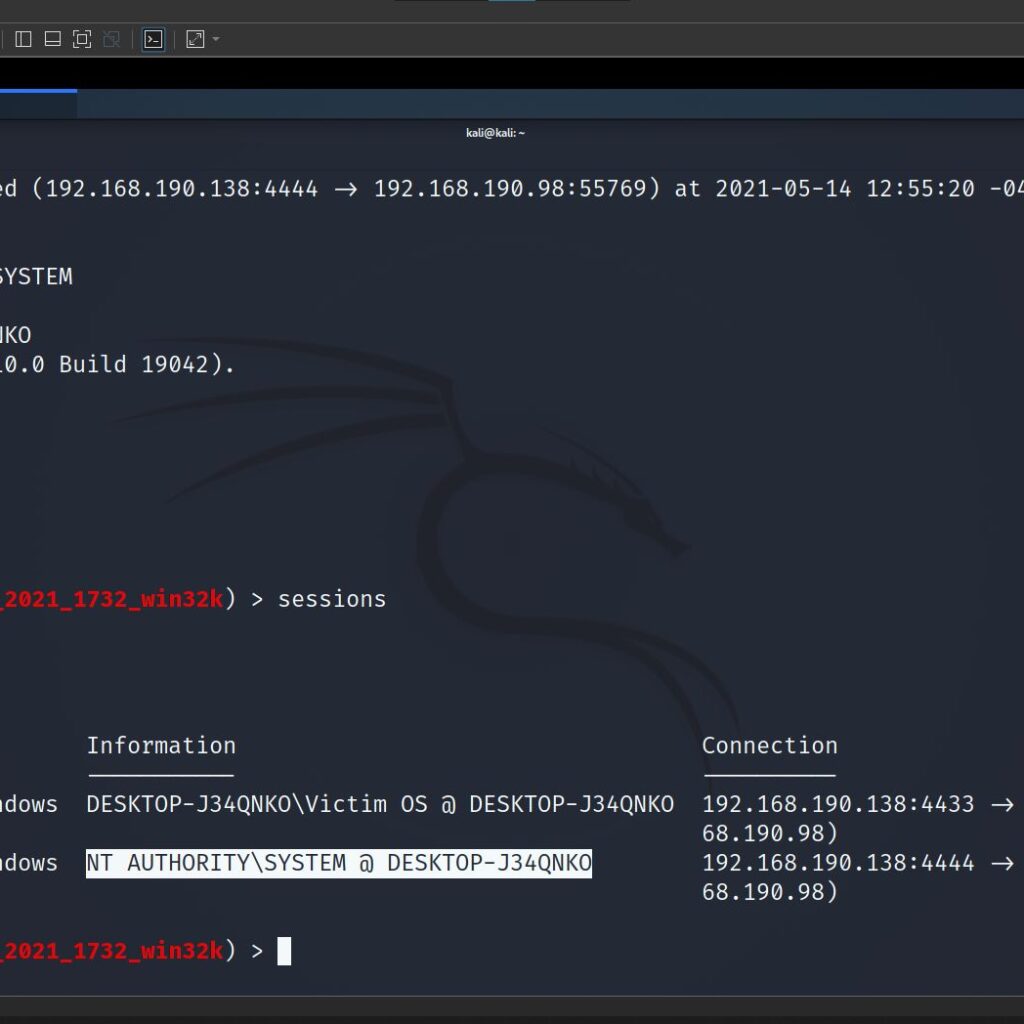
CVE-2021-1732 is a Win32k local privilege escalation in win32kfull.sys. By flipping the 0x800 bit on tagWND with NtUserConsoleControl and returning a fake value from a user-mode callback inside xxxClientAllocWindowClassExtraBytes, an attacker turns the cbWndExtra length into a controllable kernel write offset and walks the token to NT AUTHORITY SYSTEM. End-to-end Metasploit PoC against Windows 10 20H2.
Eventvwr.exe UAC Bypass via mscfile: Anatomy of a Classic HKCU Registry Hijack
A walkthrough of the well-documented Windows UAC bypass that uses “eventvwr.exe”’s auto-elevate manifest plus a writable HKCU registry handler for the “mscfile” shell verb. Writing a single REG_SZ value under “HKCUSoftwareClassesmscfileshellopencommand and launching “eventvwr.exe” via “ShellExecuteEx” with the “runas” verb causes Windows to silently spawn the attacker’s payload at High integrity — no consent prompt. S12 reproduces the technique in a small C++ tool, demonstrates near-universal AV evasion on Kleenscan, and discusses the detection footprint.
CVE-2026-40369: Arbitrary Kernel Address Increment via NtQuerySystemInformation
CVE-2026-40369 is a Windows kernel bug in “nt!ExpGetProcessInformation” that lets any unprivileged process — including one inside Chrome’s renderer sandbox — increment three DWORDs at an attacker-chosen kernel address per syscall, with no race condition, no heap spray, and 100% determinism. This deep dive walks Ori Nimron’s full exploit chain: KASLR via the prefetch side-channel, arbitrary kernel “read” via “CmpLayerVersions” type confusion (built on the Windows UTF-8 conversion path), token-privilege bitmask increment to grant SeDebugPrivilege, code injection into a SYSTEM process, and a clean restore of “CmpLayerVersionCount” at the end. Rewritten from the canonical pwn2nimron.com writeup with all original IDA decompilations and the PoC reproduced verbatim.
Dirty Frag: A New Linux Page-Cache Privilege Escalation Class
Dirty Frag is a Linux kernel local privilege escalation class abusing zero-copy networking, skb fragments, and in-place crypto to corrupt page cache memory and gain root privileges.
Vulnerability: When Microsoft Defender Becomes the Primitive – RedSun PoC.
This vulnerability shows how Windows Defender file handling can be abused through filesystem races, Cloud Files APIs, and reparse points to redirect privileged writes and escalate from a low-privileged user to SYSTEM.
Recovery Mode Breakdown: Turning macOS Recovery Safari into Root Persistence
A macOS Recovery Mode Safari flaw allowed attackers to write arbitrary files to system partitions. By placing a malicious LaunchDaemon in /Library/LaunchDaemons, an attacker could achieve persistent root execution after reboot.