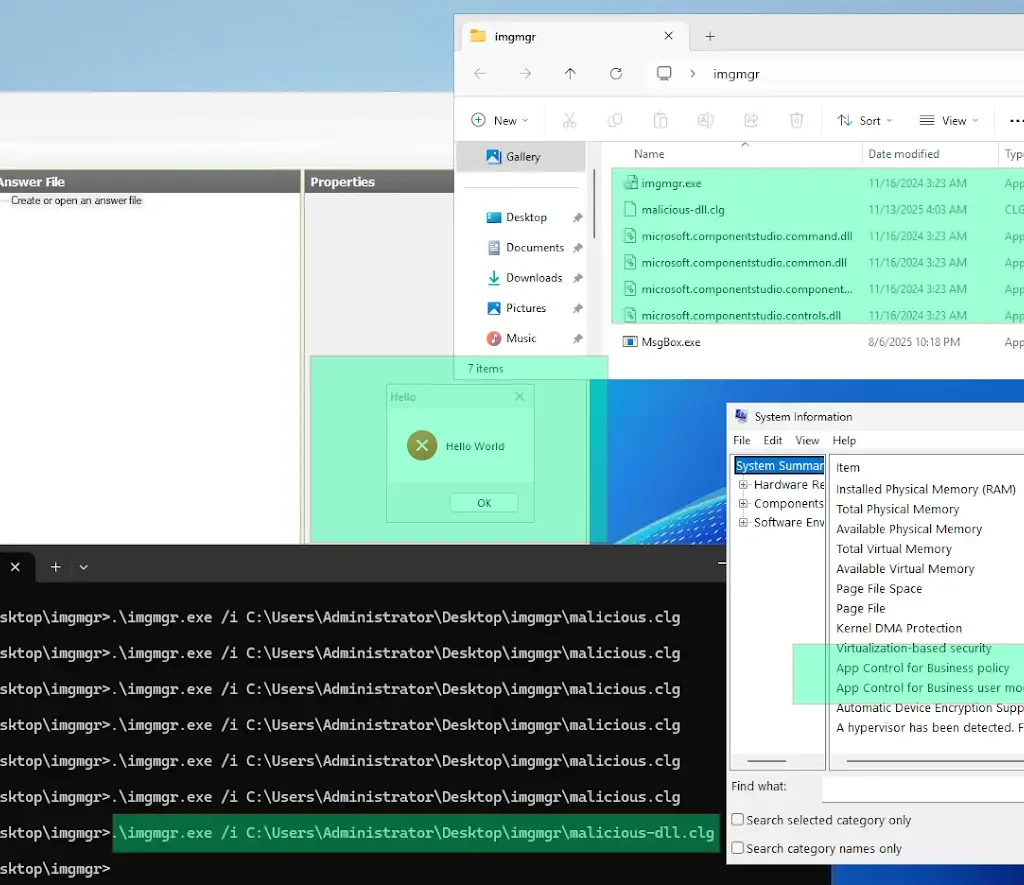

RemotePE Lazarus in-memory RAT title banner from the Fox-IT writeup

RemotePE: Inside Lazarus’s In-Memory RAT and Its DPAPI-Keyed Three-Stage Loader Chain

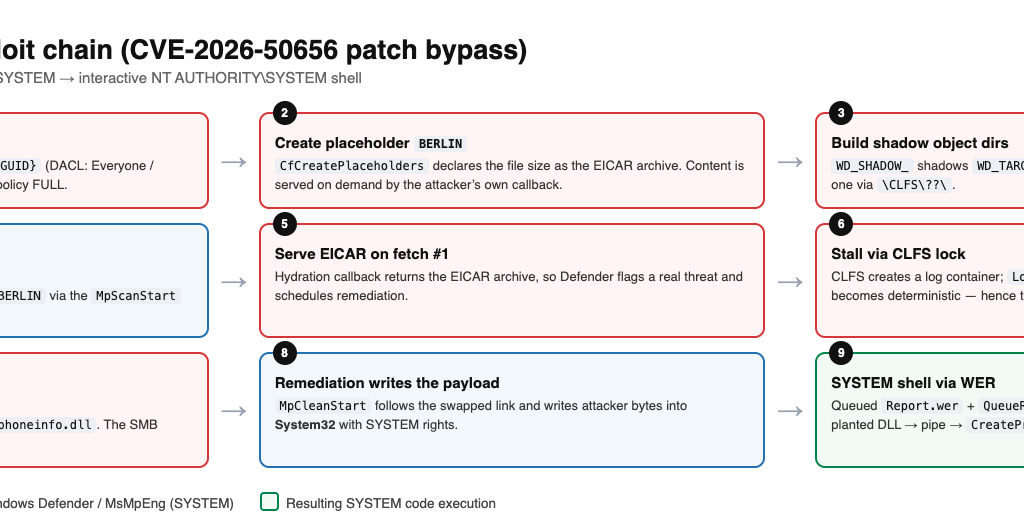
Fox-IT (NCC Group) details RemotePE, a North-Korean Lazarus in-memory RAT delivered through a three-stage chain — DPAPILoader (environmentally-keyed first-stage), RemotePELoader (HellsGate / ETW-patched HTTP beacon) and RemotePE itself, which never touches disk. The writeup walks AES-GCM C2, MSZIP-compressed command batches, the IConsole / IFileExplorer / IProcess command surface, infrastructure, MITRE ATT&CK mapping, and a full IOC set spanning July 2023 — May 2026.

NASM CVE-2026-6068 attack demo (heap UAF to persistent RCE)

CVE-2026-6068 — NASM Heap UAF Turns Into Persistent RCE Through a Dependency-File Symlink Trick

A heap use-after-free in NASM’s response-file parser (CVE-2026-6068) sounds boring — until the dangling pointer is reused as a filename for fopen(). Project SEKAI’s breakingbad turns it into a deterministic, supply-chain-style persistent RCE that overwrites the victim’s ~/.bashrc through a 120-character heap-spray label, a shipped symlink, and the unescaped shell metacharacters in NASM’s Makefile-style dependency output. No ASLR, NX, PIE, RELRO or stack-canary bypass needed. Still unpatched at disclosure.

Diagram explaining the PHP object deserialization flow in Roundcube CVE-2025-49113

Roundcube CVE-2025-49113: Authenticated PHP Object Deserialization to RCE in Open-Source Webmail

CVE-2025-49113 is a critical authenticated remote-code-execution flaw in Roundcube webmail — the default in cPanel, Plesk, and many hosting stacks — caused by insufficient validation of the _from upload parameter that lets attackers inject malicious PHP-serialized objects into session storage. The bug went undetected for nearly a decade and reportedly exposes more than 53 million hosts across all Roundcube 1.1.0–1.6.10 builds.

Three-stage TREVEX workflow: Test Case Generation, Execution and Leakage Detection, Result Classification

TREVEX: Black-Box CPU Fuzzing Finds FP-DSS, New FPVI Variants, and Zero-at-ret

TREVEX is a post-silicon black-box CPU fuzzer from CISPA designed to discover data-flow transient execution vulnerabilities without needing RTL access, an ISA emulator, or a leakage contract. The framework runs across 20 microarchitectures from Intel, AMD, and Zhaoxin and uncovers a new TEA — Floating Point Divider State Sampling (FP-DSS, CVE-2025-54505) — on AMD Zen and Zen+, a new FPVI variant on AMD that does not need denormal inputs, three instances of Zero-at-ret on Intel, and FPVI on Zhaoxin. The authors weaponise FP-DSS from native code, the Linux kernel, and a Chrome JavaScript exploit.
{“_yoast_wpseo_title”: “TREVEX: Black-Box CPU Fuzzer Finds FP-DSS (CVE-2025-54505)”, “_yoast_wpseo_metadesc”: “TREVEX black-box CPU fuzzer (CISPA, S&P 2026) finds FP-DSS (CVE-2025-54505), new FPVI variants, and Zero-at-ret across 20 Intel, AMD, Zhaoxin microarchitectures.”, “rank_math_title”: “TREVEX: Black-Box CPU Fuzzer Finds FP-DSS (CVE-2025-54505)”, “rank_math_description”: “TREVEX black-box CPU fuzzer (CISPA, S&P 2026) finds FP-DSS (CVE-2025-54505), new FPVI variants, and Zero-at-ret across 20 Intel, AMD, Zhaoxin microarchitectures.”}

iOS application hardening and mobile security protection concept

Essential iOS Hardening: A Practical Guide to Defending iPhones Against Modern Spyware

A practical, security-engineering view of the essential iOS hardening steps every iPhone user — and especially high-risk targets — should apply: Lockdown Mode, Advanced Data Protection, attack-surface reduction, deep reboots, and detection with tooling like iVerify. Based on and credited to “Essential iOS Hardening Steps” by Officer’s Notes, published on Medium (Technology Hits).