core-jmp

core-jmp

death of core jump

  • Home
  • windows
  • Reverse Engineering
  • exploitation
  • shellcode
  • About
  • Privacy Policy
  • CE SSRF VERIF 20260615-001 – Share Token Test
  • CE PageEditor VERIF 20260615-002 – Share Token Test

HomeWinDBG

Posts in category: WinDBG

Peeling Back the Socket Layer: Reverse Engineering Windows AFD.sys

Peeling Back the Socket Layer: Reverse Engineering Windows AFD.sys

March 16, 2026
by oxfemale cppIOCTLkernelkernel-modeNetworkReverse EngineeringTCP/IPwinapiwinapiWinDBGwindowsWinsock

The research reverse-engineers Windows AFD.sys, showing how TCP sockets can be created, connected, and used by sending handcrafted IOCTL requests directly to the kernel driver—completely bypassing the Winsock networking API.

Read More
Reverse engineering undocumented Windows Kernel features to work with the EDR

Reverse engineering undocumented Windows Kernel features to work with the EDR

March 14, 2026
by oxfemale AntivirusBypassingDefenderEDREventlogkernelMalwareProtectionReverse EngineeringSecuritywinapiwinapiWinDBGwindows

This article demonstrates how to reverse engineer the Windows 11 kernel to understand undocumented internals behind memory operations and ETW Threat Intelligence events, helping security engineers improve EDR telemetry and detect remote process memory writes.

Read More
Exploiting a Kernel Read/Write Primitive using BYOVD

Exploiting a Kernel Read/Write Primitive using BYOVD

March 13, 2026
by oxfemale BYOVDcppDriverEDRexploitationkernelkernel-modeReverse EngineeringWinDBGwindows

The article explains how attackers exploit a vulnerable signed driver (BYOVD) to obtain a kernel read/write primitive. It shows how unsafe IOCTL handlers allow manipulating kernel memory and abusing driver functionality for offensive operations.

Read More
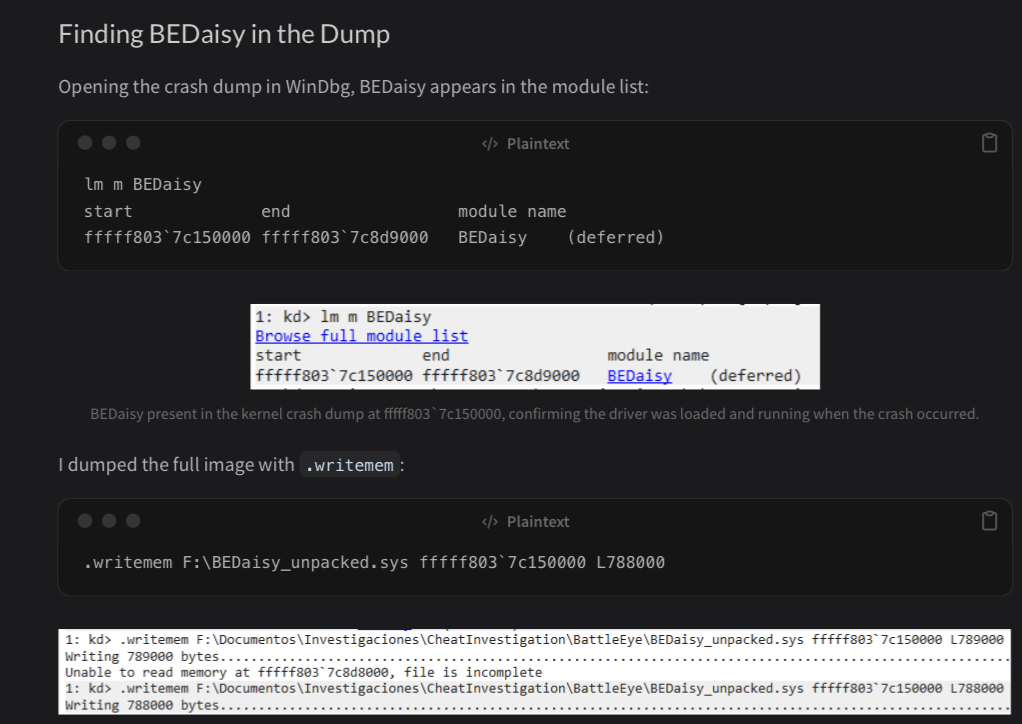
Reversing BEDaisy.sys: Static Analysis of BattlEye's Kernel Anti-Cheat Driver

Reversing BEDaisy.sys: Static Analysis of BattlEye’s Kernel Anti-Cheat Driver

March 9, 2026
by oxfemale APCDebugkernel-modewinapiWinDBGwindows

The article analyzes the Windows kernel driver BEDaisy.sys, used by BattlEye anti-cheat. Through static reverse engineering, it explores driver architecture, APC usage, hardware fingerprinting, import handling, and detection mechanisms used to monitor system activity.

Read More
Defeating Windows DEP Using ROP Chains Leveraging VirtualAlloc

Defeating Windows DEP Using ROP Chains Leveraging VirtualAlloc

March 2, 2026
by oxfemale buffer overflowDebugDEPexploitationROPshellcodeWinDBGwindows

Uses manual Return-Oriented Programming (ROP) to chain existing code fragments and call VirtualAlloc, changing memory permissions to bypass Windows DEP and then execute shellcode in exploited process memory.

Read More
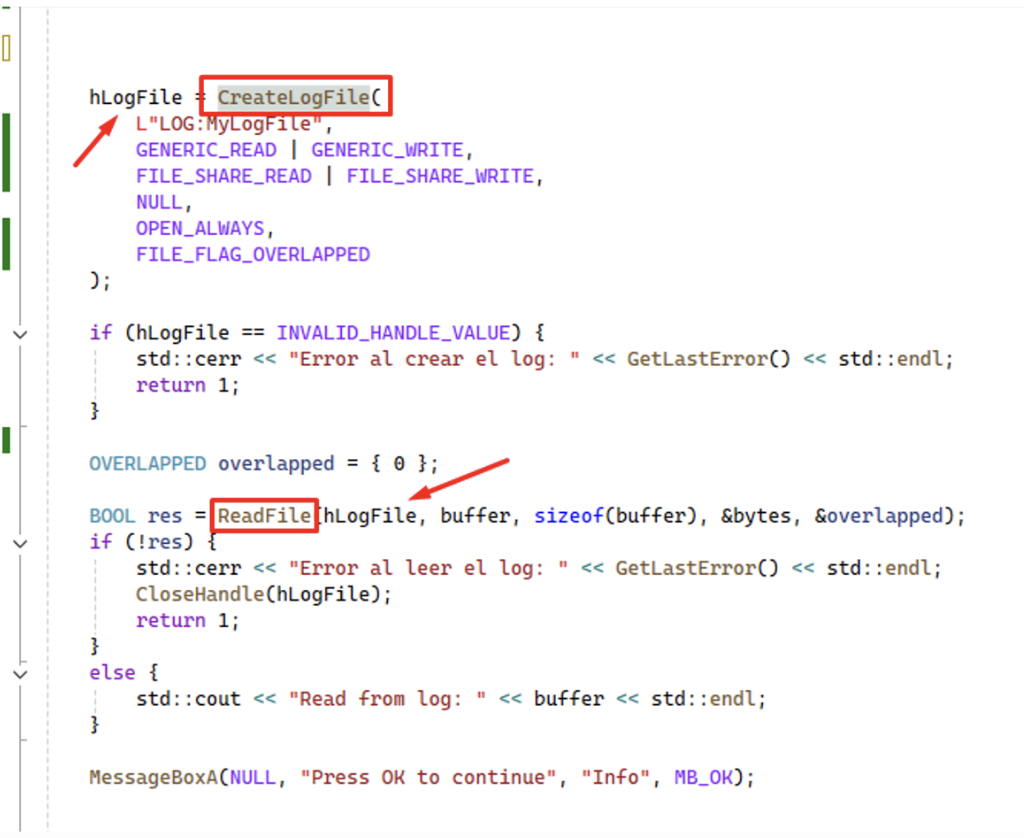
Using ReadFile with Handle of Opened .blf Log File Produces an Unrecoverable State in CLFS.sys Causing a BSoD

Using ReadFile with Handle of Opened .blf Log File Produces an Unrecoverable State in CLFS.sys Causing a BSoD

February 26, 2026
by oxfemale BSoDCLFSDriverexploitationPoCwinapiwinapiWinDBGwindows

CVE-2026-2636 Logic bug in Windows’ CLFS driver: calling ReadFile on a .blf log handle pushes CLFS.sys into an unrecoverable state and triggers an immediate BSoD — local DoS with only user privileges.

Read More
Windows Kernel Debugging

Windows Kernel Debugging

February 23, 2026
by oxfemale DebugEscalationkernelkernel-modeNetworkPrivilegeProtectionSecurityWinDBGwindows

The article explains how to set up Windows kernel debugging over a network using WinDBG and a host/target configuration. It covers enabling debug mode, connecting WinDBG to a remote VM, and using kernel debug infrastructure for low-level inspection and manipulation.

Read More
  • First
  • Previous
  • 1
  • 2

Recent Posts

  • CVE-2018-8611 — Exploiting the Windows Kernel Transaction Manager (Part 1/5: Introduction)
  • tabby — A Minimal Position-Independent Windows x64 Shellcode Framework, Built Entirely on Linux
  • CuSafe — Catching Memory Corruption on Commodity NVIDIA GPUs (USENIX Security ’26)
  • Exploiting CVE-2024-1065 via the Page Cache — A Physical-Page UAF in the ARM Mali GPU Driver
  • Weaponizing Writable SMB Shares to Steal Domain Credentials

Archives

  • June 2026
  • May 2026
  • April 2026
  • March 2026
  • February 2026
  • January 2026
  • November 2025
  • September 2025

Active Directory byovd bypass CVE Defense Evasion EDR EDR Bypass EDR Evasion Endpoint Security Exploit Development Ghidra IoT Security kernel Kernel Driver Kernel Exploitation Linux Kernel Linux Kernel Exploitation Local Privilege Escalation macOS Security Malware Analysis Malware Development Memory Corruption NTLM Relay Offensive Security Post-Exploitation PPL Privilege Escalation Process Injection RCE red team Red Teaming Red Team Techniques remote code execution Reverse Engineering ROP Security Research shellcode Threat Detection Vulnerability Research WinDBG windows Windows 11 Windows Internals Windows Kernel Windows security

Categories

  • .NET
  • access
  • ACE
  • ACL
  • Active Directory
  • Active Directory
  • AD CS
  • Administrator
  • AI Agents
  • AI Security Research
  • alloc
  • ALPC
  • AMSI
  • Android
  • Antivirus
  • Apache Tomcat
  • APC
  • Apple Silicon
  • Application Security
  • ASM
  • ASR
  • attaks
  • Audio
  • AV
  • BIOS
  • BitLocker
  • Blue team
  • Bluetooth
  • Boot ROM
  • Broadcom
  • BSoD
  • buffer overflow
  • BYOUD
  • BYOVD
  • Bypassing
  • Cache
  • Callbacks
  • Camera
  • CI/CD
  • CIMOM
  • Cisco
  • Citrix
  • Claude AI
  • CLFS
  • cmd
  • COM
  • Command Injection
  • Containers
  • Copilot
  • Cortex XDR
  • CPL
  • cpp
  • CPU
  • Credential Attacks
  • Crypt
  • Cryptography
  • CryptoPro
  • CSRF
  • Cybersecurity
  • DCOM
  • Debug
  • Defender
  • DEP
  • Deserialization
  • DFIR
  • DLL Sideloading
  • DMA
  • DNS
  • Driver
  • dump
  • EDR
  • EDR Evasion
  • Embedded
  • Encryption
  • Escalation
  • ESP32
  • ESXi
  • Evasion
  • Eventlog
  • Exploit Development
  • exploitation
  • filesystem
  • Firewall
  • firmware
  • Flash
  • FreeBSD
  • Fuzzing
  • Gadgets
  • GATT
  • Ghidra
  • Hardware
  • Hooking
  • Hyper-V
  • Hypervisor
  • Impacket
  • impact
  • Injection
  • IOCTL
  • iOS Security
  • IoT
  • IPC
  • IRP
  • Java
  • JIT
  • JWT Security
  • Kerberos
  • kernel
  • kernel-mode
  • LDAP Relay
  • Library
  • Linux
  • LLM
  • LLM Exploit Development
  • LNK
  • Loader
  • LOLExfil
  • LSA
  • LSASS
  • Machine Learning
  • MacOS
  • Malware
  • Malware Development
  • MCP
  • Memory Management
  • Mobile Security
  • MS-DOS
  • MS-EVEN
  • MS-LSAD
  • MS-SAMR
  • Network
  • NTLM Relay
  • NVMe
  • ODR
  • Operating Systems
  • Palo Alto
  • PBA
  • PCI
  • PEB
  • Penetration Testing
  • pets
  • PHP
  • pipe
  • Plugins
  • PoC
  • powershell
  • powershell
  • PPL
  • Privilege
  • Privilege Escalation
  • Process Injection
  • Protection
  • PXE
  • Python
  • QEMU
  • Race Condition
  • radare2
  • RCE
  • Recall
  • Recovery mode
  • Red Team Operations
  • RedTeam
  • Registry
  • Reverse Engineering
  • root
  • ROP
  • RPC
  • RTTI
  • Rust
  • SAM
  • Secure Boot
  • Security
  • Security
  • shellcode
  • Shortcut
  • SMB
  • SMTP
  • SPI Flash
  • SSDT
  • Stack Overflow
  • STM32H5
  • Systems Programming
  • TCP/IP
  • TEB
  • Telegram
  • Telnetd
  • Threat Intelligence
  • TPM
  • UAC
  • UART
  • UEFI
  • Uncategorized
  • USB
  • Use-After-Free
  • user-mode
  • Virtualization
  • VMProtect
  • VMware
  • Vulnerability Analysis
  • Warbird
  • WASM
  • WEB
  • winapi
  • winapi
  • WinDBG
  • windows
  • Windows Admin Center
  • Winsock
  • WMI
  • WML
  • Wordpress
  • WSL
  • XenServer
  • Xiaomi
  • XML
  • XNU Kernel
  • XSS
  • XXE
Log in
    © 2026 core-jmp. All rights reserved.
    Shopping Basket